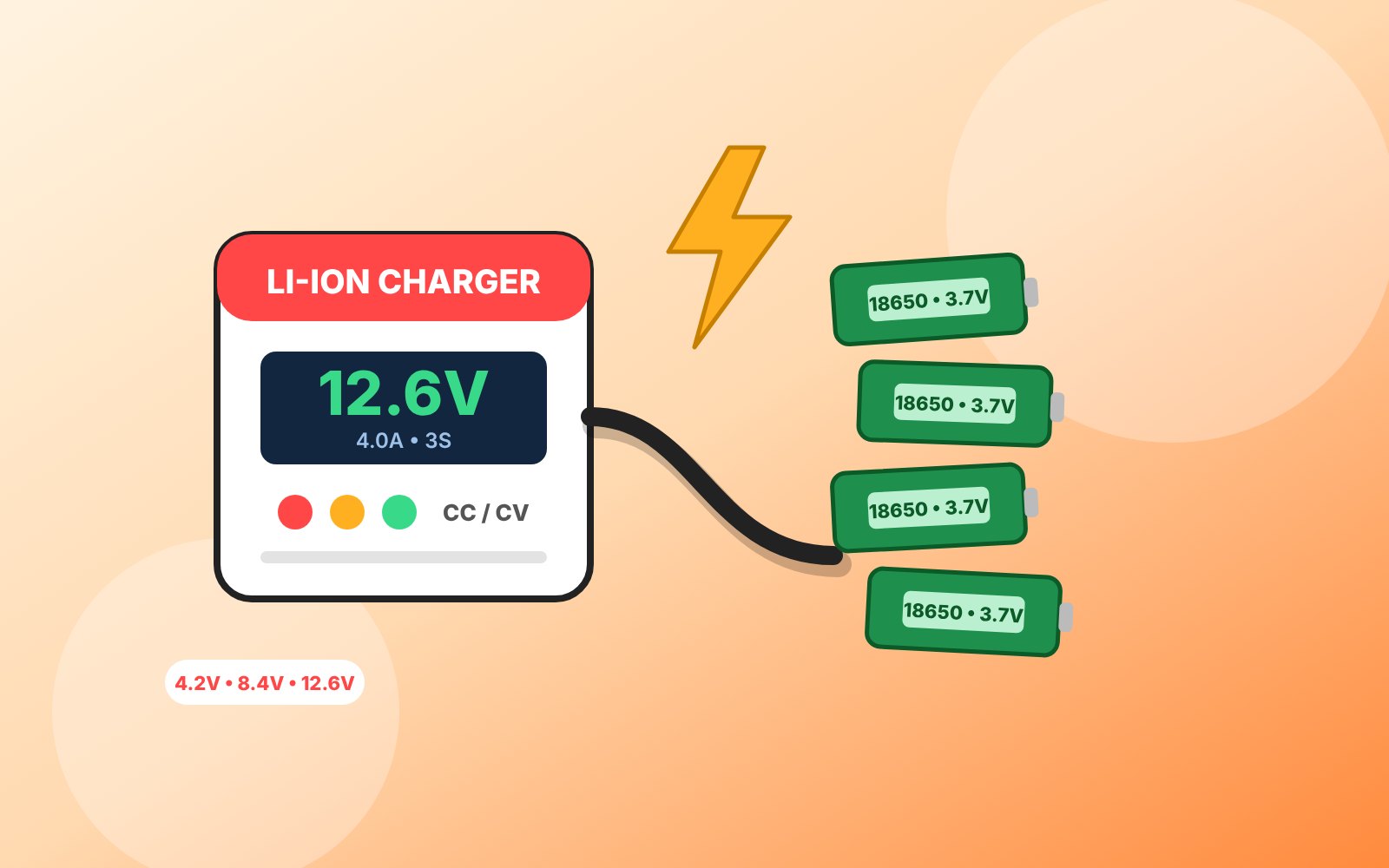
Load shedding has made DIY power banks, router UPS units and spare 18650 battery packs a very Pakistani hobby — but the charger is where most people go wrong. The wrong voltage can wreck a battery pack or worse, and the wrong current can wear it out in months. In this guide we explain which lithium battery charger you need (4.2V, 8.4V or 12.6V), how to size the current, how a smart charger works and the safety habits that matter — plus a free charger-finder calculator and the chargers we stock.
Quick answer: choose your charger in 3 steps
- 1. Count the cells in series (S). 1S = 4.2V, 2S = 8.4V, 3S = 12.6V charger. A 3S pack needs a 12.6V charger.
- 2. Pick the current. Aim for about 0.5C — half the pack’s Ah rating. A 10 Ah pack suits a 4–5A charger; a 2.5 Ah pack suits about 1A.
- 3. Use a smart CC/CV lithium charger with a proper BMS on multi-cell packs, and never charge unattended.
- Never use a lithium-ion charger on lead-acid or LiFePO4 batteries (and vice versa).
Lithium-ion basics: what does 1S, 2S, 3S mean?
A single lithium-ion cell (like an 18650) is nominally 3.6–3.7V and is fully charged at 4.2V. Connect cells in series and the voltages add up. The “S” number tells you how many cells are in series, and the charger must match it exactly.
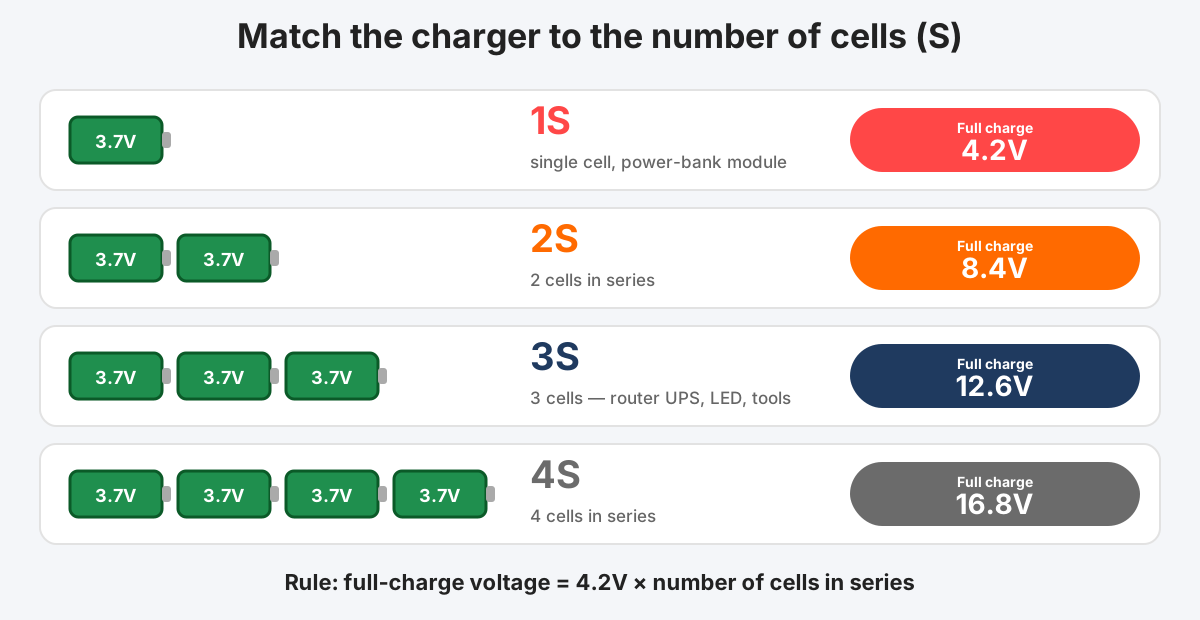
Cells connected in parallel (the “P” number, such as 3S2P) keep the same voltage but add capacity. So a 3S2P pack with 2500 mAh cells is a 12.6V charger job with 5 Ah of capacity.
Lithium chargers we stock
Every charger below is matched to a specific cell count. Prices and stock update automatically from our store.
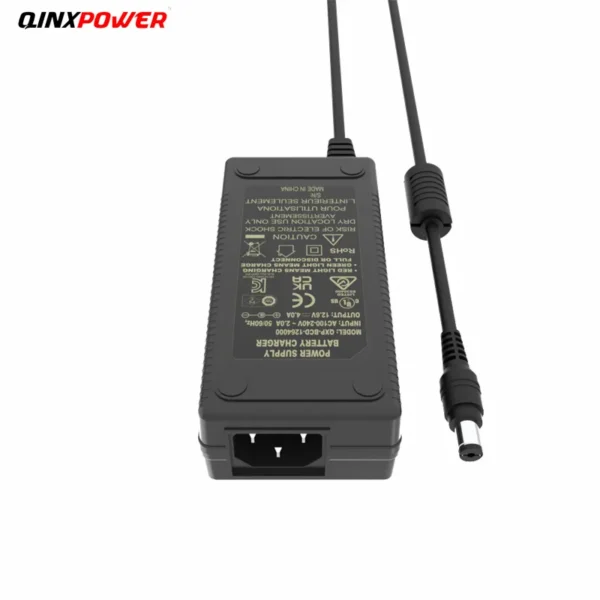
12.6V 4.0A Lithium Battery Charger / 3S 18650 High-Current Li-ion Smart Charger
A 12.6V 4A smart charger for 3S 18650 lithium-ion packs. The extra current charges bigger packs much faster, so it is the one to choose for large 3S2P, 3S3P or 3S4P battery builds.
- 12.6V output for 3S lithium-ion
- 4A charging current
- Designed for 3S 18650 packs
- Smart Li-ion charging
Best for: Large 3S packs of roughly 8 Ah and above — big power banks and UPS packs.
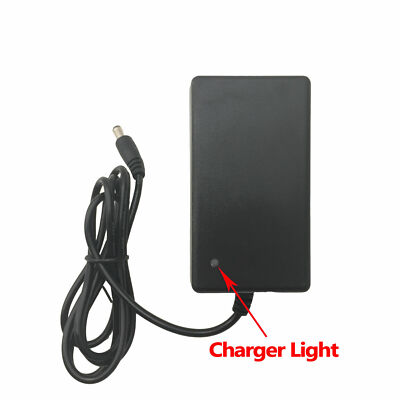
12.6V 2.0A Lithium Battery Charger / 3S 18650 Li-ion Smart Charger
A 12.6V 2A lithium battery charger — a balanced choice for medium 3S packs that charge in a sensible time without stressing the cells.
- 12.6V output for 3S lithium-ion
- 2A charging current
- For 3S lithium-ion packs
- Compact charger
Best for: 3S packs of roughly 4–8 Ah, router mini-UPS and portable lighting.
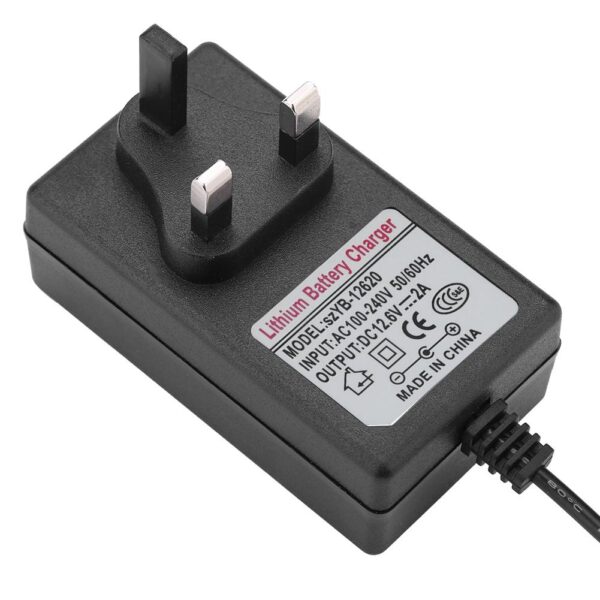
12.6V 1.0A Lithium Battery Charger / 3S 18650 Li-ion Smart Charger
A 12.6V 1A lithium battery charger. The lower current is kinder to small packs and a good fit when you are not in a hurry.
- 12.6V output for 3S lithium-ion
- 1A charging current
- Gentle, low-stress charging
- Budget friendly
Best for: Small 3S packs of about 2–4 Ah and overnight-style slow charging at home (supervised).
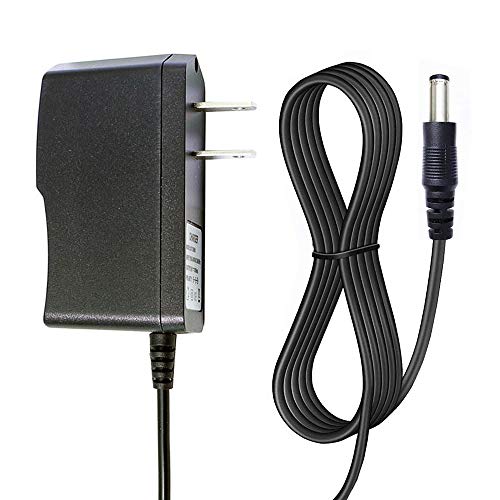
8.4V 2.0A Lithium Battery Charger / Dual-Cell 18650 Li-ion Smart Charger
An 8.4V 2A lithium battery charger for two-cell (2S) lithium-ion packs such as 7.4V packs used in small tools, lamps and radios.
- 8.4V output for 2S lithium-ion
- 2A charging current
- For 7.4V (2S) packs
- Compact charger
Best for: 2S packs: torches, small speakers, hobby gadgets.
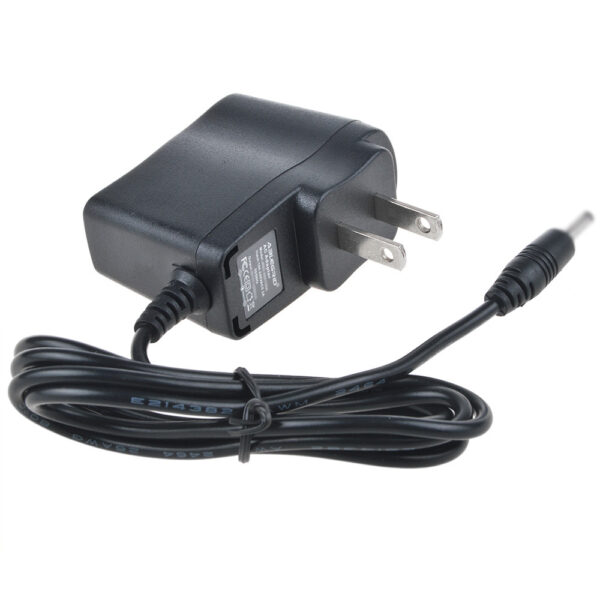
4.2V 2.0A Lithium Battery Charger / 18650 Li-ion Smart Charger
A 4.2V 2A lithium battery charger for single-cell lithium-ion packs. Best suited to 1S packs of about 4 Ah and up, such as two 18650 cells in parallel.
- 4.2V output for 1S lithium-ion
- 2A charging current
- For single-cell 3.7V packs
- Compact charger
Best for: 1S power-bank modules and bigger single-cell packs.
How much charging current do you need?
Charging current is measured against the pack’s capacity: 1C means charging at the Ah rating (a 2 Ah pack at 2A). For long life, most lithium-ion cells are happiest at 0.5C or lower, unless the cell datasheet clearly allows more. Too much current heats the cells and shortens their life; too little only takes longer.
| Charger | Good for | Example |
|---|---|---|
| 12.6V 1A | 3S pack of about 2 Ah or more | e.g. 3S1P with 2500 mAh cells |
| 12.6V 2A | 3S pack of about 4 Ah or more | e.g. 3S2P (about 5 Ah) |
| 12.6V 4A | 3S pack of about 8 Ah or more | e.g. 3S4P (about 10 Ah) |
| 8.4V 2A | 2S pack of about 4 Ah or more | e.g. 2S2P (about 5 Ah) |
| 4.2V 2A | 1S pack of about 4 Ah or more | e.g. 1S2P (about 5 Ah) |
Free charger-finder calculator
Choose your pack layout and cell capacity and the calculator suggests the voltage, the right current and an estimated charge time.
Which charger do I need?
Pick your pack layout. Estimate only — always follow your cell datasheet and BMS ratings.
How a smart lithium charger works
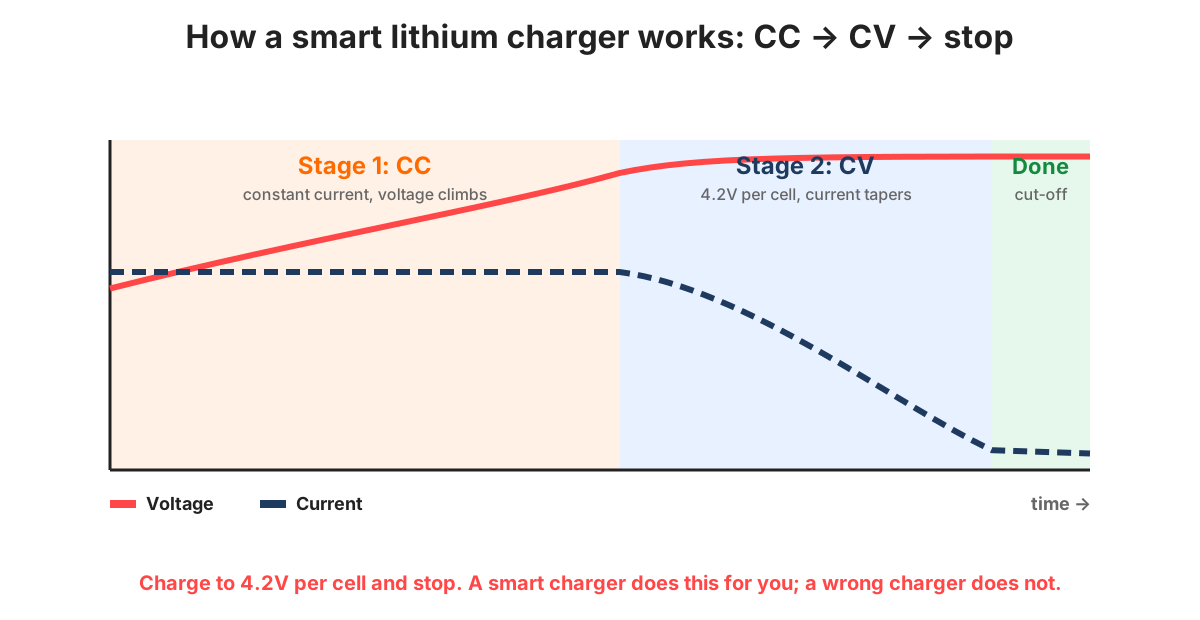
Good lithium chargers use CC/CV charging. First they push a constant current until the voltage reaches 4.2V per cell, then hold that voltage while the current falls away, and finally stop. This is why the last 10% takes longer than the first 80%.
A BMS is not optional on packs
A battery management system (BMS) balances the cells and protects against over-charge, over-discharge and short circuits. The charger supplies the right voltage; the BMS looks after each individual cell. Multi-cell packs should always have one.
Do not mix chemistries: Li-ion, LiFePO4 and lead-acid
All three can sit in a “12V” setup, yet each needs a different charger. Using the wrong one can undercharge, overcharge or damage the battery.
| Battery type | Full-charge voltage per cell | 12V-class pack | Charger needed |
|---|---|---|---|
| Lithium-ion (18650, 3.6 / 3.7V) | 4.2V | 3S = 12.6V | Li-ion charger (CC/CV, 4.2V per cell) |
| LiFePO4 (3.2V) | 3.65V | 4S = 14.6V | LiFePO4 charger only |
| Lead-acid (12V battery) | about 2.3–2.4V per cell | about 13.8–14.4V | Lead-acid charger |
In other words, a 12.6V lithium-ion charger is not suitable for a 12V lead-acid car or UPS battery, and not for a LiFePO4 pack. If you are planning home backup, read our guide on solar systems, batteries and LiFePO4.
Popular ways Pakistanis use lithium chargers
- DIY power banks: a 1S or 3S 18650 pack with a USB boost module to charge phones during load shedding.
- Router and modem backup: a 3S pack with a 12V regulator keeps Wi-Fi alive for hours. See our power adapter and power supply guide for matching voltages.
- Emergency lights and LED strips: small 2S or 3S packs.
- Tools and gadgets: replacing or recharging packs in cordless tools, torches and speakers.
Charging safely
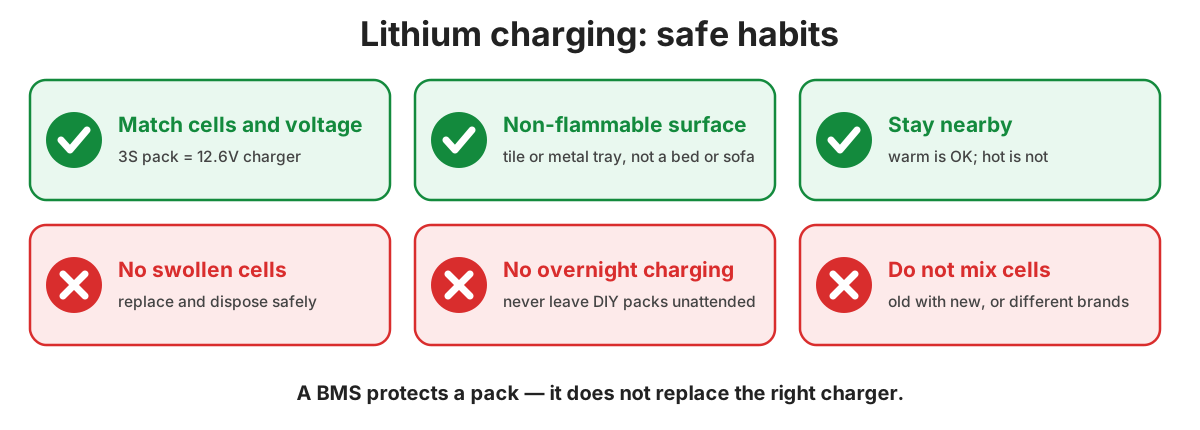
- Match the charger to the pack. Check the S number and voltage before every connection.
- Check polarity. Red is positive; reversing it can destroy a charger or battery.
- Use a hard, non-flammable surface and keep the pack away from curtains, beds and sofas.
- Do not leave packs charging unattended or overnight, especially home-built ones.
- Stop using damaged cells. If a cell is swollen, hot, dented or smells odd, retire it and dispose of it safely.
- Never mix old and new cells, or different brands and capacities, in one pack.
- Keep cells at room temperature. Do not charge a very cold or very hot battery.
How to spot a poor-quality charger
- Wildly wrong output. With a multimeter, a 12.6V lithium charger should read close to 12.6V with nothing connected. A reading far above that is a red flag.
- Feather-light body with no markings. Look for clear input and output ratings printed on the label.
- Gets very hot within minutes at low load.
- No smart indicator. Good chargers show charging and full status.
- Too-good-to-be-true current ratings on a tiny, cheap box.
Chargers in stock now
Lithium battery chargers
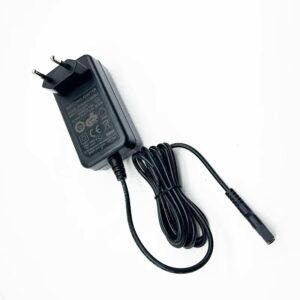 ZD24W342060EU 34.2V 0.6A EU Plug 2 prong Power Charger…
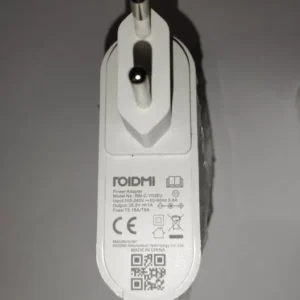 Original Roidmi 34.2V Power Adapter Charger for F8 F8E…
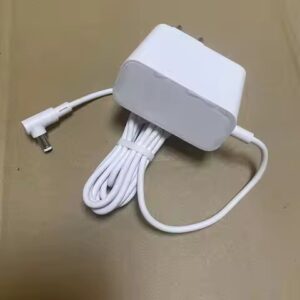 Original Xiaomi 27V Power Adapter Charger for G20 Lite…
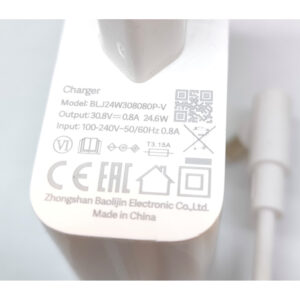 Original Xiaomi Mi 30.8V 0.8A Power Adapter Charger BLJ24W308080P-V…
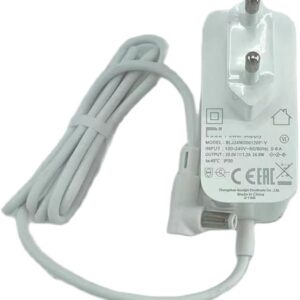 Power Adapter EU Plug for Xiaomi S10T Robot Vacuum…
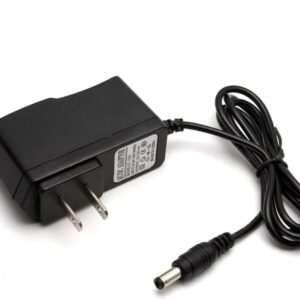 20V Cordless Drill and power tool Battery Charger Power…
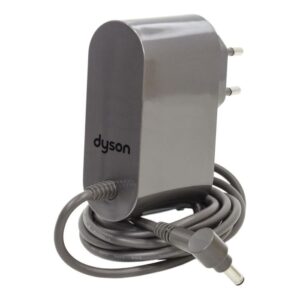 Original Dyson 30.45V 1.1A Power Adapter Charger for V10…
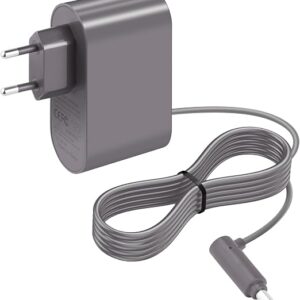 Original Dyson Vacuum Cleaner Charger 26.10V for V6 V7…
Frequently asked questions
Which charger do I need for a 3S 18650 battery pack?
What does 3S2P mean?
Can I charge a 12V lead-acid battery with a 12.6V lithium charger?
Can I charge a LiFePO4 battery with a Li-ion charger?
How long does it take to charge a lithium battery pack?
Is it safe to leave lithium batteries charging overnight?
What is the difference between a charger and a power adapter?
Do your chargers come with warranty and cash on delivery?
Final verdict
Count your cells, choose the matching charger voltage, keep the current around 0.5C, use a smart CC/CV charger and a BMS on multi-cell packs, and never take shortcuts with safety. For most DIY 3S projects, the 12.6V 2A is the sweet spot, the 12.6V 4A suits bigger packs and the 12.6V 1A is a gentle choice for small ones.
Check our latest products: browse all battery chargers and batteries. Tell us your pack layout on WhatsApp and we will suggest the right charger.